 RealAware
Pankaj Sharma
Founder & CEO, Product Architect
Builds the product, its governance, and the evidence record it leaves behind.
LinkedInRealAware brings together the operating evidence, shows what is missing, and routes a bounded action to the person responsible. Your team approves every governed write.
After a request we reply to agree a time, then spend those 25 minutes on one production problem you bring.
Less time between detecting a production problem, making a defensible decision, and proving recovery. These are the outcomes a pilot is designed to test against your own baseline, not results measured across an installed base.
TodayA well falls below baseline. Response can stall while teams gather context and coordinate the next action.
With RealAwareA review-ready response is drafted while the well is still off baseline.
TodaySignals, work history, and operating limits live in different places.
With RealAwareOne response carries the evidence, gaps, bounded action, and accountable owner.
TodayWork complete is often treated as problem solved.
With RealAwareThe loop closes only after the physical signal confirms the outcome.
Start with one asset group and one recurring exception family. Establish the baseline, review drafts in shadow mode, then enable one approved execution path when the agreed gates are met. We agree the baseline before the first loop runs, then calculate from your timestamps, rates, and economics.
Approximately 90 days: baseline, shadow review, one governed action path, and an outcome review. Shadow review is a phase inside the engagement, not a separate trial.
A named operating owner, agreed read-only data exports from the systems in scope, and access to the people who already respond to these exceptions. We estimate the effort with you before signing rather than quoting a number here.
At the review we compare response time, recovery, and your effort against the agreed baseline, and decide together whether to expand, enable a further write path, or stop. Success criteria and the commercial next step are agreed before the pilot begins.
Three separate intervals, not one blended number: detected → review-ready draft, draft → approval, approval → verified recovery.
Whether the intervention restored the physical signal to the agreed operating range.
Affected production rate × shortfall fraction × delay in days × the value per unit you agree. Every input is yours and visible; if the rate you supply is already the lost-production rate, we do not multiply by the shortfall again. This is modelled production value at risk, not cash saved.
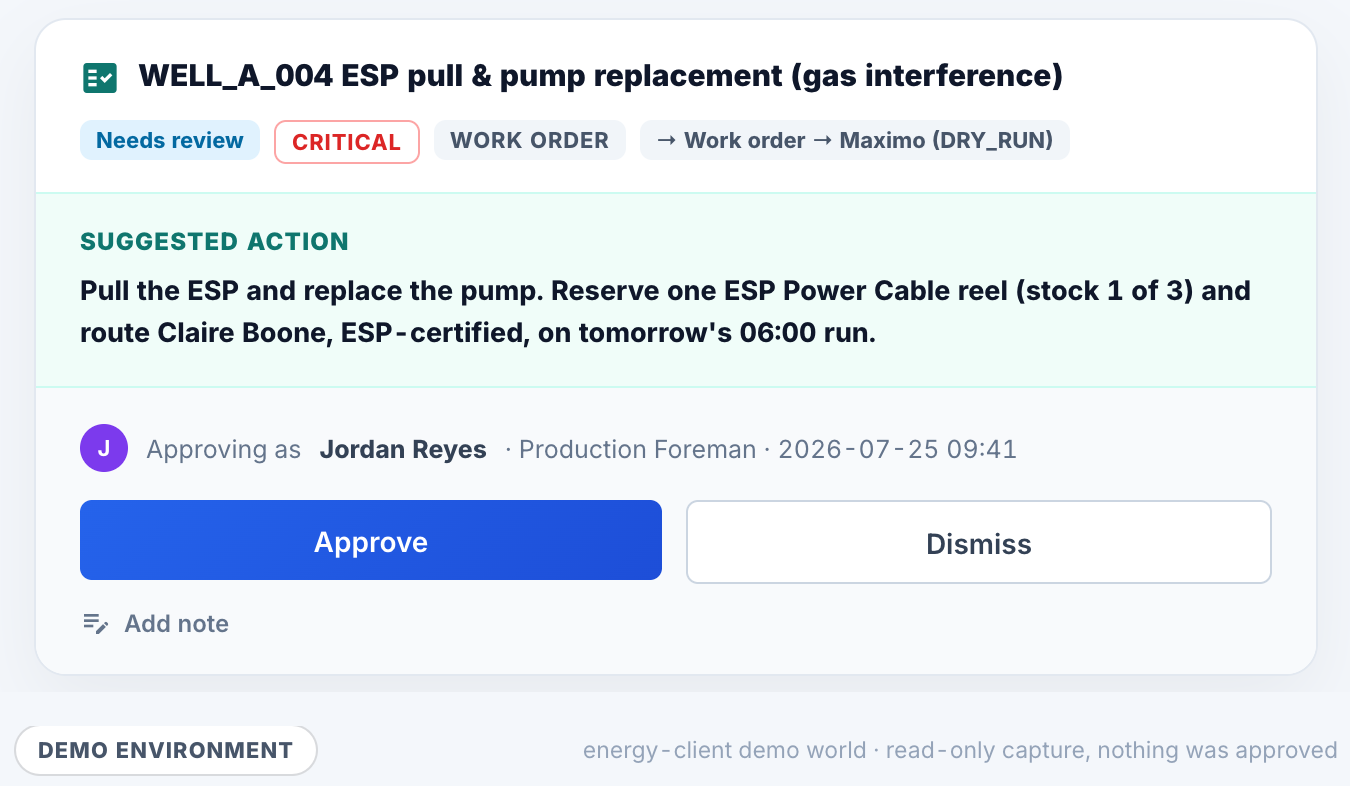
The evidence, operating context, bounded action, and accountable owner meet on one screen.
RealAware reads from the systems you keep, coordinates the response, and writes only where you explicitly enable it. It is not a replacement for any row below.
Produces the signals, analysis, and recommendations we read as evidence.
Assembles evidence, routes named approval, governs writes, and verifies the outcome.
Remains authoritative for operational facts, work, and transactions. Governed writes land here, or nowhere.
Security review comes first: what we read, where it runs, who approves, and what can ever be written. The overview is dated and states which deployment configurations are available today and which have been validated in a customer environment — those are not the same list.
Only the sources you connect. Your systems remain authoritative.
Hosted on Google Cloud in a project dedicated to your operation.
Every draft stops at an accountable person. The decision and evidence stay together.
Connections remain DRY_RUN until you enable them, one system at a time.
Software and upstream operating experience, working directly with your team.
Builds the product, its governance, and the evidence record it leaves behind.
LinkedIn
Keeps the product grounded in field work and operator approval.
LinkedIn
Works with operating teams through the first response loop and pilot.
LinkedInIn 25 minutes, we’ll map where response time disappears and what a governed loop would need to prove.
Or watch the 90-second walkthrough, or why response delay matters.